


Craig Watson • December 4, 2025

October 2025 Review

October Review

By Adam Novakovic

In the month of Halloween, October energy price movements were free of jump-scares. Whilst prices moved up slightly at the start of the month, they marginally decreased throughout the remainder of October. Ending the month slightly below the levels seen at the end of September.


The expectation this month was that European gas reserves would be the key story impacting energy prices. The European Network for Transmission System Operators for Gas (ENTSOG) released their report on the Winter supply outlook. This confirmed that Europe is well prepared for the coming winter, with 83 % gas reserves recorded as of the 1st of October, and infrastructure resilient enough to meet demand without Russian pipeline gas. Their projections had Europe ending the winter season with over 30% storage even in the most severe scenarios.

There is also the expectation that any unforeseen supply disruptions can be mitigated through increased LNG imports -- supporting the EU’s goal of phasing out Russian gas while emphasising continually reducing demand.


During the first week of October Russia launched a wave of drone attacks against Ukraine -- the largest since the war began. These strikes have damaged Ukrainian gas production and left storage at 42% of capacity. This has forced Ukraine to look at importing large quantities of LNG from Europe this winter.

With the deal that brought Russian gas to Europe now expired, Europe faces added demand pressure. This comes despite Europe significantly reducing Russian gas imports and increasing LNG imports from other nations.

With there currently being a large quantity of LNG available for importation, and with EU gas reserves being in a healthy position, it seems as though further conflict may not have a large impact on energy prices. This could change however if Europe were to experience a particularly cold winter. 

Outlook

As we head into the colder months, weather becomes an increasingly large factor in how short-term prices move. So far, forecasts have been suggesting a warmer than normal November and December with wind output also expected to be above the seasonal norms. Should the forecasts prove to be accurate, we would expect wholesale energy prices to drop steadily throughout the winter months, but any colder-than-expected periods could lead to faster reserve usage, therefore increasing the competition for near-term LNG purchases.


Global LNG supplies are currently looking healthy with there being cargoes available for purchase should extra gas be required. LNG has long been seen as a cheaper alternative to traditional fossil fuels.

With many new supplies now ramped up and ready to export, we are seeing LNG supply being in a healthier position than ever before. When many of the forecasts for LNG demand were made a few years ago, many countries were experiencing a steady growth in energy consumption. This pattern has not continued with rising prices forcing many to review their energy usage causing LNG demand to stutter. With the demand side of the equation not growing proportionally to the supply, we could see this surplus supply cause LNG prices to drop, which would in turn lower wholesale energy costs. Without geopolitical events having a negative impact on prices, the LNG supply-demand picture could cause a steady drop in energy prices over the coming months.

Decreasing energy demand could also be further exacerbated by the US issuing large tariffs against China. Previous tariffs saw a drop in Chinese production which lowered their energy demands and saw China selling excess LNG -- adding to the already disproportionate supply-demand balance. Should this happen again, energy prices will be set to drop throughout the winter months.


If your business would like more information about how these developments impact your energy procurement, or you would like advice on any business energy related needs, get in touch with SeeMore Energy today. Our team of expert advisors can help with a range of issues, and ensure you’re not paying any more than necessary for your gas and electricity.

Outlook

With European buying pressure dropping off and there being no clear, imminent threats to supply, it seems as though prices could be set to drop over the coming months. However, long-term weather forecasts are now suggesting that this could be a cooler winter than first predicted. In September, climate experts published findings that showed there is a 71% chance of transitioning to a La Niña weather pattern during the final quarter of 2025. This weather pattern is associated with colder than average temperatures in Europe. A cooler winter increases the amount of gas that will need to be consumed and increases the rate at which gas reserves will be used.


If your business would like advice regarding any of the topics mentioned in this article, or with its energy procurement, management, or planning, then don’t hesitate to contact 
Seemore Energy. Our team of experienced advisors can help you with bespoke strategies and advice that is tailored to your needs.

By Craig Watson March 27, 2026
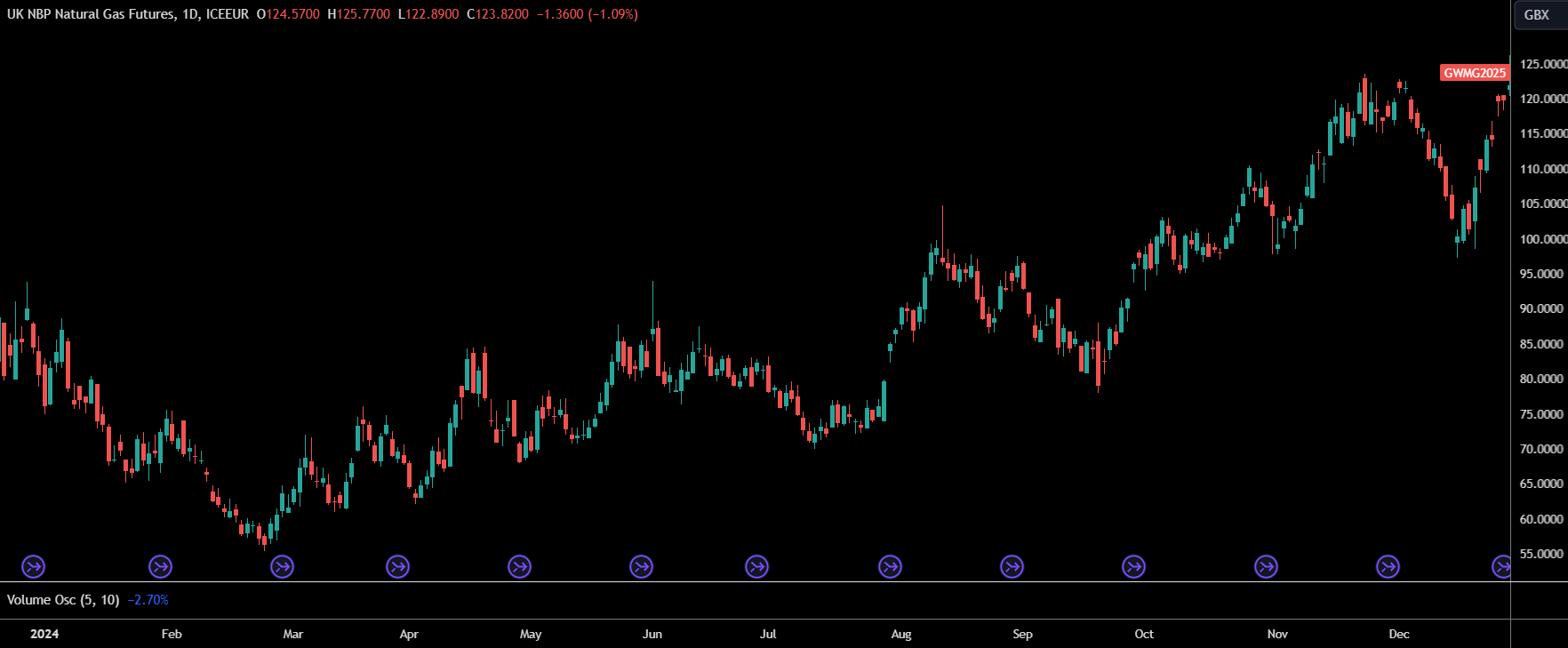
2024 Review By Adam Novakovic In a year that began with falling energy prices, there were recurring catalysts that led to prices climbing steadily higher. Geopolitical uncertainty and the perennial threat of escalating conflicts meant fear would maintain a constant presence in the wholesale markets. We will look back at the key energy stories from 2024, and how the energy markets are likely to shape up in 2025. Quarter 1 The year began with cautious optimism as the UK’s gas reserve levels were healthy and prices for the Summer’24 season were in freefall. In February, prices pulled back to their lowest levels since 2021, and for the first time in a while, we identified that there was greater potential for upside risk than for further downward price movement: “ there now (exists) an asymmetrical element of risk should the market encounter a supply-side problem of significance. ” During February we had advised customers on flexible contracts that this was an ideal time for making purchases. March would see prices begin to ascend again as international conflict would create problems with LNG imports, and we would highlight the geopolitical risks as an area for concern moving forwards: “ fears remain and there are potential negative catalysts that could lead to prices rising further, with the main factors to watch out for being based on geopolitical unrest. “ For a business that purchases their energy in advance, this quarter was the optimal time for purchasing during 2024. In February, electricity prices for Winter’25 were down to 7.75p/Kwh, and as low as 6.05p/Kwh for Summer’25. Winter’25 ended the year with prices above 11.1p/Kwh, with Summer’25 prices exceeding 9p/Kwh. For a company that uses 500,000Kwh of electricity per month, the difference between buying at the February low point compared to today’s prices would represent a yearly saving of over £200,000.
By Craig Watson December 4, 2025
September Review By Adam Novakovic We have reached the time of year where the summer months have started to fade and we begin to think about the colder seasons. This month saw the UK government recognise Palestine as a country, although they still seem unable to recognise the harm their energy policies are causing UK businesses. With further charges set to be added to UK energy bills and rising non-commodity costs, it was a relief that wholesale energy prices remained fairly flat throughout September. A recent report from independent analysts Cornwall Insights revealed that large energy users who aren’t covered by Government schemes could find that they are paying a further £450,000/year in non-commodity costs by 2030. With non-commodity costs such as DUOS and TUOS charges –which are used to fund the infrastructure responsible for the transmission of electricity – now accounting for over 2/3rds of total electricity costs for some businesses, it is of growing concern that these charges are set to continue rising. With the TUOS charges for 26/27 expected to increase significantly , the non-commodity charges are starting to have a negative impact on UK businesses ability to compete against foreign businesses with fewer governmental charges on their energy bills. This growing concern is yet to be addressed but could have a huge impact on many industries in the next year.

Show More